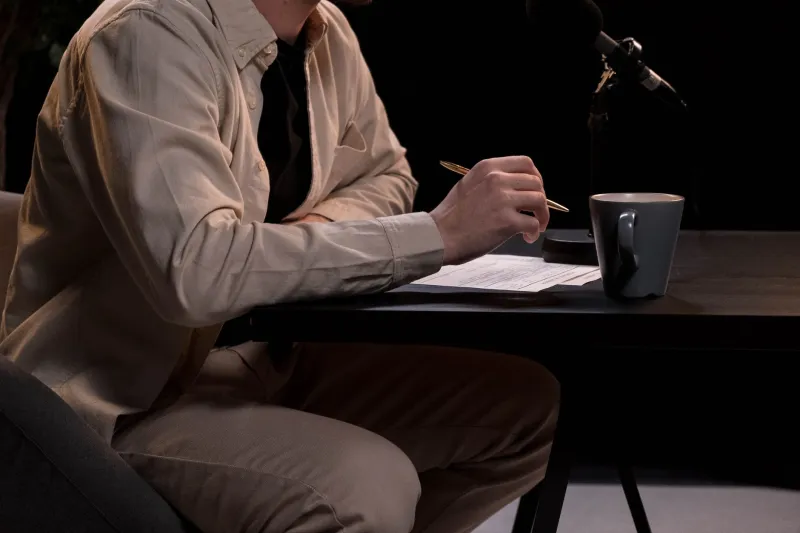
Nobody Planned That: How Unscripted Moments Between Two People Become Comedy Gold

There's a clip floating around the internet — you've probably seen it — where two podcast hosts are mid-sentence talking about something completely mundane, and then one of them says something slightly off, the other one catches it, and within about four seconds they've both completely lost it. No punchline. No setup. Just two people cracking each other up in real time.
The comments? Thousands of people saying some version of "I've watched this seventeen times and I'm still crying."
Here at Rebecca & Ellen, we live in that space. A lot. And honestly, it got us curious: what is it about those unplanned, zero-polish moments between two people that hits so differently than a perfectly timed late-night monologue joke?
So we went digging.
The Joke Nobody Wrote
Spontaneous humor — the kind that bubbles up between two people mid-conversation — operates on a completely different psychological track than crafted comedy. According to researchers who study humor and social bonding, laughter that emerges from genuine surprise activates the brain's reward centers more intensely than anticipated humor. In other words, your brain actually likes being caught off guard more than it likes waiting for a punchline it sort of saw coming.
Comedians have known this instinctively for decades. The late Robin Williams famously couldn't stick to a script in interviews because something in the room would catch his attention and he'd just go. The audience always loved those moments more than anything rehearsed.
But here's what's interesting: spontaneous humor almost always needs a second person to really land. You can be funny alone, sure. But the comedic comeback — the riff, the callback, the perfectly timed "wait, what did you just say?" — that's a two-player game.
Why Two People? The Chemistry Equation
When two people have genuine rapport, their conversations develop what communication researchers call "co-constructed meaning" — basically, they're building on each other's thoughts in real time without needing to consciously plan it. In comedy terms, that translates to one person setting something up without even knowing it, and the other person knocking it down before either of them fully registers what happened.
Think about some of the most viral duo moments from the last few years. Whether it's a pair of sports commentators losing their composure over something absurd happening on the field, or two content creators who've been riffing together for years suddenly discovering a bit that writes itself — the through line is always the same. They know each other well enough that their timing is almost unconscious.
Podcast producer and comedy writer Jamie Herrera, who works with several duo-format shows, describes it this way: "The funniest moments I've ever captured in a recording booth happened when both people forgot the mic was on. The second someone becomes self-conscious about being funny, the funny leaves the room."
That tracks with something Rebecca and I have noticed in our own recording sessions. The episodes where we were most relaxed — maybe slightly underprepared, definitely over-caffeinated — tend to be the ones listeners quote back to us. The episodes where we both showed up with color-coded notes? Solid. But rarely the ones that make people lose it.
The Audience Knows When You're Faking It
Here's the uncomfortable truth for anyone trying to manufacture authenticity: you can't. Audiences — especially podcast listeners and YouTube viewers who spend hours with the same voices every week — develop an almost eerie sensitivity to when something is real versus when it's been workshopped.
Comedic authenticity researcher Dr. Priya Nair (whose work focuses on parasocial relationships and entertainment media) has written about how audiences process "performed spontaneity" differently from actual spontaneity. Essentially, when we watch two people genuinely surprise each other, we feel like we're in the moment with them. When we watch two people pretend to be surprised, something in our brain quietly files it under "fine, but not that memorable."
This is why some of the biggest viral comedy moments from duo creators in the past few years have been accidents. A technical glitch. A guest who went completely off-script. One person mispronouncing something in a way that opened up a ten-minute rabbit hole neither of them expected to go down.
You cannot plan that. And the audience knows.
What Actually Makes the Comeback Land
So if you can't force it, what can you do? Comedy writers and podcast hosts who work in duo formats tend to point to a few consistent factors:
Trust is the foundation. When two people genuinely trust each other, they're not monitoring themselves for mistakes. And in that unguarded space, the funny stuff lives. The comedic comeback — the quick, sharp response that makes a moment — requires someone to be relaxed enough to catch what just happened and react to it before the moment passes.
Specificity beats generality every time. The funniest unscripted moments are almost always about something extremely specific — a weird word choice, a very particular observation, an inside reference that the audience gets to feel included in. Generic banter rarely goes viral. Weird, hyper-specific banter that feels true to who those two people are? That's the stuff.
Letting it breathe matters. A lot of duo content is over-edited in a way that cuts out the pause before the comeback — which is actually where the comedy lives. That half-second of one person realizing what the other just said? That's the setup. Don't cut it.
What We've Learned (The Hard Way)
Look, we're not going to pretend we've always gotten this right. There have been episodes where both of us were clearly trying to be funny, and it landed with all the grace of a soggy paper plate. And there have been episodes where we were genuinely just talking, something happened, and we both knew in the moment that this was the clip.
The difference, as best we can tell, is presence. When you're actually listening to the other person — not waiting for your turn to talk, not mentally reviewing your notes — you catch things. And catching things is where the comedy is.
Spontaneous humor between two people isn't really about being naturally funny. It's about being genuinely there, with someone you actually know, in a moment that neither of you controlled.
And honestly? That's the only formula that's ever worked.