Better Together: The Real Reason Creative Duos Keep Outrunning the Solo Stars

When Rebecca and I first started talking about what we wanted this project to be, there was a version of the conversation where we each considered just... doing our own thing. Solo podcast. Solo blog. Full creative control, answer to nobody, make all the decisions yourself.
We've both laughed about that version of events since. Because here's what we've figured out over time, and what a pretty compelling pile of research backs up: the solo route sounds appealing until you're three weeks in and you've lost all perspective on whether anything you're making is actually good.
Creative partnerships — real ones, built on complementary strengths rather than identical tastes — consistently produce work that neither person would have made alone. And the reasons why are more interesting than you might expect.
What the Research Actually Says
Let's start with the data, because it's genuinely surprising even if the conclusion feels intuitive.
A widely cited study from researchers at Northwestern University found that the most impactful creative work — measured by influence, longevity, and critical reception — was disproportionately produced by collaborative teams rather than solo creators. This held across fields as different as scientific research, film, and music. The sweet spot, interestingly, wasn't large teams. It was small ones. Two to three people, working in close creative proximity, consistently outperformed both lone operators and large committees.
The reason isn't just "more hands make lighter work." It's more specific than that.
When two people with genuinely different skill sets and perspectives work on the same creative problem, they each catch things the other misses. One person's blind spot is the other's area of instinctive focus. That dynamic — sometimes called cognitive complementarity — creates a feedback loop that solo creators simply can't replicate internally, no matter how good they are.
The Accountability Factor (It's Bigger Than You Think)
Here's the part that doesn't get talked about enough in the "creative partnerships are great" conversation: accountability.
When you're working alone, the only person who knows you skipped a week of work is you. And you're pretty easy to negotiate with. You'll reschedule with yourself. You'll give yourself extensions. You'll convince yourself that the idea you had at 11pm on a Tuesday was actually great and doesn't need another look in the morning.
A creative partner changes all of that immediately.
Not because they're your boss — the dynamic doesn't work if it's hierarchical. But because you genuinely don't want to let them down. Because their investment in the project is visible to you in a way that an abstract audience's investment isn't. Because when someone else has skin in the game, you show up differently.
Podcast researchers who've studied the growth trajectories of independently produced shows have noted that duo-hosted podcasts have significantly higher episode consistency rates than solo-hosted ones — meaning they publish more regularly, skip fewer weeks, and maintain production quality over longer periods. The accountability isn't incidental to the creative output. It is part of the creative output.
Case Studies Worth Looking At
You don't have to take the research on faith. The real-world examples make the pattern pretty hard to ignore.
Rhett & Link, who built one of YouTube's most durable entertainment franchises over more than a decade, have talked openly about how their creative relationship works precisely because they challenge each other constantly. Neither of them, by their own admission, would have pushed as far or stayed as consistent without the other person in the room.
Tegan and Sara, the Canadian indie pop duo who've built a loyal US fanbase over 20-plus years, have described their songwriting process as a kind of creative argument — two people with overlapping but distinct aesthetic instincts who push each other toward something neither would reach alone. Their catalog reflects that tension in the best possible way.
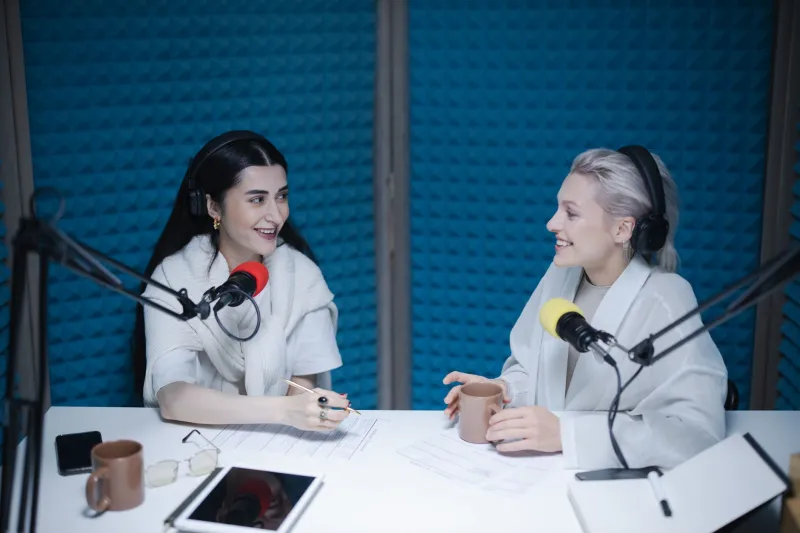
In the podcasting world, shows like My Favorite Murder (Karen Kilgariff and Georgia Hardstark) didn't just succeed because of the subject matter — they succeeded because the chemistry between two specific people created something audiences couldn't get from a solo host covering the same material. The duo format was the product, not just the delivery mechanism.
Different Brains See Different Problems
One of the most practically useful things about creative partnerships is what researchers call "perspective diversity" — the idea that two people with different backgrounds, instincts, and areas of expertise will literally perceive the same creative problem differently.
This sounds obvious. But the implications are worth spelling out.
When you're working alone, you tend to gravitate toward solutions that match how your brain already works. You solve problems the way you've always solved problems. A creative partner — especially one who doesn't think like you — forces you to articulate why you're making a choice, which is often the moment you realize the choice wasn't as solid as you thought.
It's not comfortable, necessarily. But comfort and creative growth are not typically found in the same zip code.
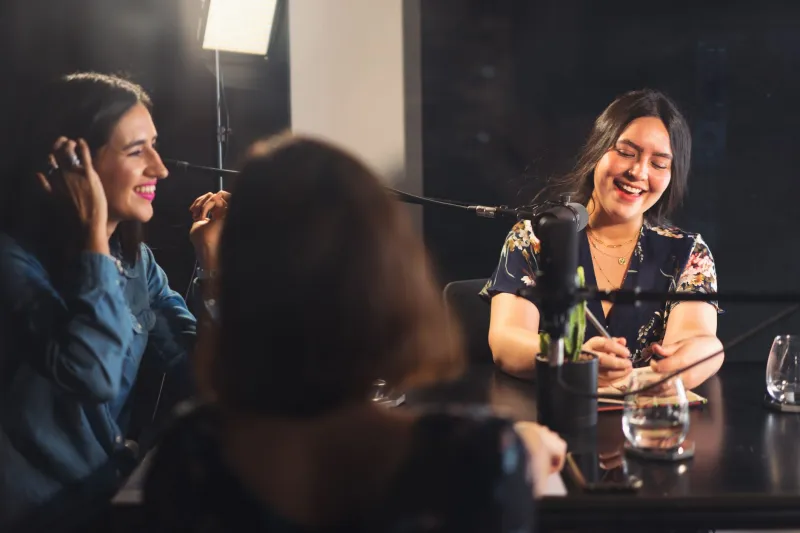
For Rebecca and me, this shows up constantly. There are angles on topics that one of us finds immediately obvious and the other finds genuinely puzzling — and working through that gap almost always produces something more interesting than either of us would have landed on independently. The friction is the feature.
So Why Does Solo Work Still Get Romanticized?
Fair question. The lone creative genius is a deeply embedded cultural story — the writer in the cabin, the musician with a guitar and a notebook, the visionary who doesn't need anyone else to validate their work.
And look, solo creative work is real and valid and sometimes exactly what a project needs. There are things you can only make when you're entirely inside your own head.
But the romanticization of solo work has also done a lot of creators a disservice, because it frames collaboration as a compromise — as though bringing another person in means giving something up. The research, and honestly our own experience, suggests the opposite is usually true. You're not diluting your vision. You're pressure-testing it.
What This Means for Anyone Building Something
If you're in the early stages of a creative project — a podcast, a newsletter, a YouTube channel, a band, literally anything — and you're on the fence about whether to go it alone or find a partner, here's what we'd offer from both the science and our own stumbling-through-it experience:
The right partner isn't someone who agrees with you. It's someone who cares about the same outcome but gets there differently. That tension, managed well, is where the best work comes from.
We didn't set out to be a case study in creative partnership theory. We just knew that what we were making together was better than what either of us was making separately.
Turns out, there's a whole body of research that could have told us that from the jump.