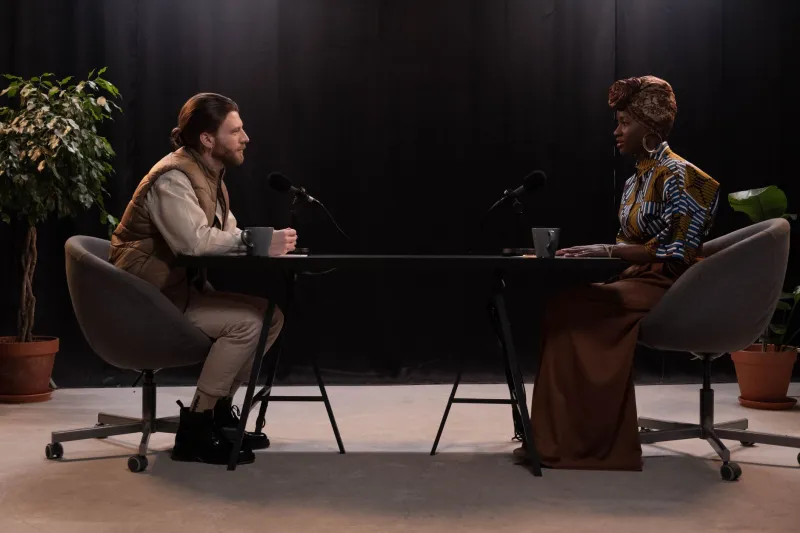
Two Heads, Half the Energy: The Uncomfortable Math of Running a Creative Duo

Somewhere between our third overbooked week in a row and the moment one of us forgot to eat lunch again, we had a reckoning. Not a dramatic one. More like a quiet, exhausted realization over lukewarm coffee: having two people on a project doesn't actually double what you can get done. In a lot of ways, it makes the whole equation messier.
And yet — we kept saying yes. To collabs, to deadlines, to favors, to "quick calls" that were never quick. Because in our heads, we were doing the math wrong.
The Two-For-One Illusion
When you're part of a duo, there's a deeply appealing story you tell yourself early on. Two brains. Two sets of hands. Two people to carry the weight. Logically, that should mean you can take on twice as much as a solo creator, right?
Except that's not how any of this works.
The moment you add a second person to a creative operation, you don't just gain capacity — you also add coordination overhead. Every decision that used to be instant now requires a conversation. Every idea needs to be communicated, agreed upon, sometimes debated, and then re-communicated to whoever's executing it. That invisible layer of back-and-forth? It's not free. It costs time, it costs energy, and it costs the kind of focused mental bandwidth that doesn't just refill overnight.
Researchers who study workplace productivity have a term for this: coordination costs. It's the friction that happens any time two or more people have to align before anything actually gets done. In a corporate setting, it shows up as endless meetings. In a creative partnership, it shows up as the forty-five-minute text thread you had to have before you could even start the thing you were supposed to be doing.
Decision Fatigue Is a Two-Player Game
Here's something nobody really prepares you for when you go into business — or content creation, or any kind of collaborative work — with another person: making decisions together is genuinely tiring in a way that making them alone isn't.
When you're solo, you decide and you move. When you're a duo, every call is a negotiation, even the small ones. Font choice. Posting time. Whether the intro is too long. Who follows up on the brand email. These feel like nothing in isolation. Stack them across a full week of content creation and you've got a very real mental load that neither of you is fully accounting for.
Decision fatigue is a well-documented phenomenon — the more choices your brain has to process, the worse it gets at processing them. And when you're splitting those choices between two people who both have opinions, both care about the outcome, and both have their own separate lives generating their own separate mental noise? You're not halving the fatigue. You're doubling the surface area for it.
The Coordination Tax Nobody Talks About
Let's get specific about what coordination actually looks like in a real creative partnership, because it's easy to hand-wave past it.
There's the scheduling layer — finding time that works for both of you, factoring in one person's day job, the other's family obligations, time zones if you're not in the same city. There's the communication layer — keeping each other updated on what's happening so nothing falls through the cracks. There's the emotional labor layer — checking in, managing morale, being the hype person when your partner's having a rough week and vice versa.
None of that shows up in a content calendar. None of it gets a line item in a project plan. But all of it takes real time and real energy from real humans who have a finite supply of both.
When we started actually tracking where our hours went in a given week — not just the creation time, but all of it — we were genuinely surprised. A significant chunk was pure coordination. Catching up, syncing up, checking in. Necessary? Absolutely. Free? Not even a little.
Why Duos Keep Overcommitting Anyway
So if the math doesn't actually work out the way we think it does, why do creative partnerships keep falling into the same trap of taking on too much?
A few reasons, honestly.
First, there's the guilt factor. When you have a partner counting on you, saying no to an opportunity feels like you're letting them down, not just yourself. So you push through and say yes, assuming the other person will somehow help absorb whatever you just agreed to.
Second, there's the comparison trap. Solo creators who are grinding hard make it look like the bar is already high. If one person can do X, surely two people should be able to do 2X, right? Except those solo creators aren't also splitting their cognitive energy across a shared creative vision. They're just doing their thing.
Third — and this one's a little uncomfortable to admit — duos sometimes use each other as cover. If we both agreed to it, neither of us has to be the person who said yes to something unsustainable. The responsibility gets diffused, which makes it easier to ignore until you're both burned out and quietly resenting the situation.
How to Actually Know When You've Hit Your Limit
The honest answer is that your real capacity is lower than your theoretical capacity, and the gap between those two things is where burnout lives.
Some markers that tend to show up before total collapse:
The quality of your conversations drops. When you and your partner are no longer riffing creatively and instead just triaging tasks, that's a sign the bandwidth is gone. You're in survival mode, not creative mode.
Small decisions start feeling impossible. If choosing a thumbnail or agreeing on a title takes way longer than it should, your collective decision-making engine is running on fumes.
One of you goes quiet. In a healthy partnership, both voices are present. When someone starts checking out — less enthusiastic, less engaged, giving shorter answers — that's usually exhaustion wearing a mask.
You've stopped saying no to anything. If every request gets a yes because the alternative feels like too much to negotiate, you've already overshot your actual capacity.
The fix isn't complicated, but it does require honesty. Build in a regular check-in — not about content, but about capacity. Ask each other directly: what's your actual bandwidth this week, not what you think it should be? Then plan from that number, not the inflated one.
The Permission to Do Less
There's something almost countercultural about a creative duo publicly deciding to do less. The hustle narrative is so loud, especially in US creator culture, that pulling back can feel like falling behind.
But here's what we've found: the work that comes out of a partnership running at sustainable capacity is almost always better than the work that comes out of two people running on empty and hoping the other one picks up the slack.
Two heads are genuinely better than one — when both heads are actually in the game. When they're depleted, you're not getting two people's best thinking. You're getting two people's worst, and you've also got coordination costs on top of it.
The math was never as simple as we wanted it to be. Accepting that is, weirdly, the most productive thing we ever did.