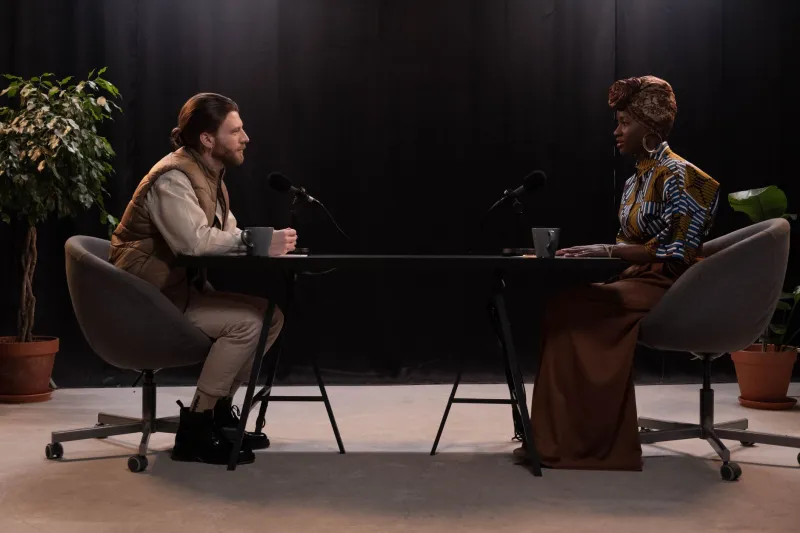
Nine-to-Five and Trying to Create: The Messy Truth About Unequal Hustle in a Duo

Let's paint a picture. It's Wednesday afternoon. One half of a creative duo is sitting at a coffee shop, laptop open, ideas flowing, editing audio or drafting scripts or pitching sponsors — fully in the zone. The other half is in a fluorescent-lit conference room on their third back-to-back meeting of the day, sneaking glances at their phone, trying to remember what it felt like to have a creative thought.
By the time they reconnect that evening, the gap between their days is enormous. And nobody talks about how weird that is.
This is one of the most quietly complicated dynamics in any two-person creative project: when the financial pressure isn't split evenly, when one person has a full-time job and the other is all-in on what you're building together. It sounds like a logistics problem. It's actually an emotional minefield.
The Guilt Loop Nobody Warned You About
Here's what nobody tells you when you start a creative project with a partner while one of you still has a day job: both people end up feeling guilty, just for completely different reasons.
The person who's all-in feels guilty for having more time. They feel guilty sending a Slack message at 2pm knowing the other person is stuck in a spreadsheet. They feel guilty making progress on something that's supposed to be shared work, because moving forward alone starts to feel like leaving someone behind. And honestly? Sometimes they resent having to slow down — and then feel guilty about that too.
Meanwhile, the person with the day job is carrying a different kind of guilt. They feel like they're not pulling their weight creatively. They show up to calls exhausted and half-present. They miss deadlines on their end of things — not because they don't care, but because there are only so many hours in a day and some of those hours belong to a boss who actually pays them. That guilt has a particular sting to it, because it's layered with helplessness. It's not like they can just quit.
Both people are suffering. Neither is talking about it clearly. That's the loop.
The Scheduling Nightmare Is Real (and It's Only Getting Worse)
Beyond the emotional stuff, there's the very practical reality of trying to coordinate two people whose daily rhythms look nothing alike.
The all-in partner might be most productive mid-morning. The day-jobber might not be mentally available until 8pm, by which point they're also trying to eat dinner, decompress, and maybe see another human being in their household. Finding a window where both people are alert, available, and actually in a creative headspace? That window is narrow. Some weeks, it barely exists.
This is where a lot of duos quietly start to unravel — not with a big blowup, but with a slow drift. The person with more time starts making more unilateral decisions just to keep things moving. The person with less time starts feeling like a passenger in something that's supposed to be a partnership. Neither of them necessarily meant for it to go that way.
Creative couples — and yes, we mean that in the broadest sense, any two people building something together — need to be intentional about this. That might mean scheduling a standing weekly creative session like it's a non-negotiable appointment. It might mean agreeing on what decisions can be made solo and what needs both voices. The structure isn't glamorous, but it's what keeps the partnership from quietly becoming a one-person show with a footnote.
Money Talks, and It's Awkward
Let's go there. When one person is earning a salary and the other is betting on the creative project to eventually pay off, the financial dynamic gets complicated fast.
Who fronts the cost of equipment? Who absorbs the expense of a conference or a tool subscription? If the project starts generating revenue — even a little — how do you split it when one person has been investing time and the other has been investing money? These questions don't have a universal right answer, but they need an actual answer. Leaving it vague is a choice, and it's usually a bad one.
Some duos operate on a sweat equity model — the person putting in more hours gets a larger cut until things even out. Others go strictly 50/50 regardless of time invested, because the creative contribution is viewed as equal even if the hours aren't. What matters less than which system you choose is that you choose one and write it down somewhere both of you can see it.
Money has a way of turning unspoken assumptions into resentments. And resentments in a creative partnership have a way of showing up on the mic, in the writing, in the energy of whatever you're putting out into the world.
The Power Shift You Don't See Coming
Here's the thing about unequal availability: it creates unequal influence, whether you intend it to or not.
The person with more time in the project naturally develops stronger opinions about direction. They've been thinking about it more. They've had more conversations with your audience, more time to notice what's working and what isn't. That's not a character flaw — it's just what happens when you're immersed in something.
But if the other partner doesn't actively push back and stay engaged, the project slowly stops being a duo project. It becomes one person's vision with another person's name attached. And when that happens, the day-jobber often starts to disengage further — not because they've stopped caring, but because it doesn't feel like theirs anymore.
The fix is less about time and more about intentional ownership. The partner with the day job has to fight harder to stay in the creative conversation, even when they're tired. And the all-in partner has to actively create space for that — not just in theory, but in practice. That might mean saving certain decisions for when they're both available. It might mean asking for input even when it would be faster to just move ahead.
What the Duos That Make It Actually Do
The creative partnerships that survive this imbalance tend to have a few things in common.
First, they talk about it openly instead of letting it fester. They acknowledge that the setup is unequal without pretending that makes it unfair — sometimes life just looks like this for a season, and naming that out loud takes a lot of pressure off.
Second, they revisit the arrangement regularly. What worked six months ago might not work now. Maybe the day-jobber got a promotion that means even less bandwidth. Maybe the project grew enough that going all-in is finally a real option. The conversation has to keep happening.
And third — maybe most importantly — they protect the creative joy. Because when a duo stops having fun together, no amount of logistical problem-solving is going to save it. The reason you started this thing was because something between you two clicked. Don't let the grind of unequal schedules bury that.
Rebecca and Ellen know firsthand that building something together is never perfectly balanced. There are weeks where one of us is carrying more, and weeks where the other one picks it up. The trick isn't finding equilibrium — it's staying honest enough with each other that the imbalance never gets to feel permanent.
Because it doesn't have to be.