Why Saying 'Thank You' Feels Like Betrayal When You're Half of a Creative Duo
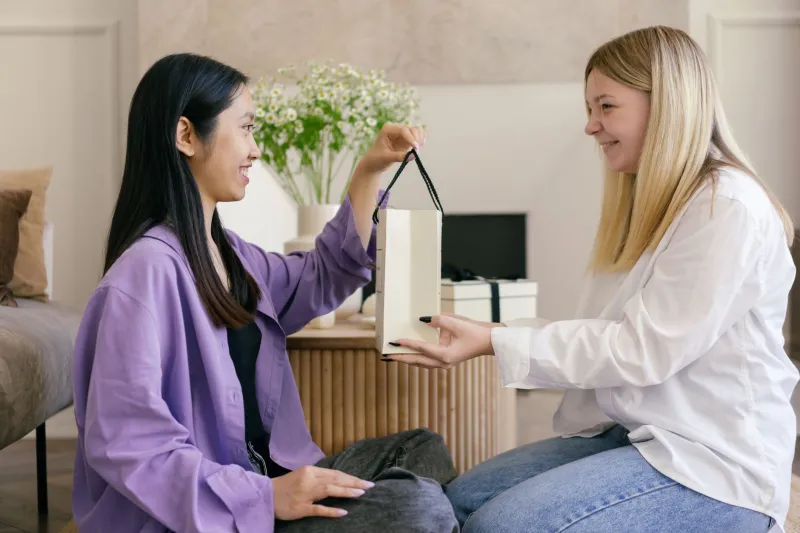
Somebody stops you after a show, slides into your DMs, or leaves a glowing comment on a post — and they're talking directly to you. Not the team. Not the brand. You. And instead of feeling that warm rush of validation you've been quietly craving, your stomach drops a little. You immediately type back something like, "Oh, it's really both of us" or "Ellen honestly did most of the heavy lifting on that one."
Sound familiar? Yeah. Us too.
This isn't false modesty for show. For a lot of creative duos, deflecting praise feels genuinely necessary — almost morally required. And unpacking why that is turns out to be way more interesting than you'd expect.
The Invisible Ledger You're Both Keeping
Here's the thing about working closely with another person on something you both care about: you start keeping score without meaning to. Not in a petty way, necessarily. It's more like a background process running in your head at all times — a rough accounting of who contributed what, who came up with the concept, who rewrote the ending at 1am, who showed up when the other one was having a rough week.
When praise lands on just one of you, that ledger gets yanked into the foreground. Suddenly you're doing frantic mental math. Did I actually earn this? What did she do that I'm not getting credit for? If they knew the full story, would they still be saying this to me?
Psychologists call this part of a broader imposter syndrome pattern, but in a duo context it has an extra layer. You're not just doubting yourself — you're also acutely aware of another person whose contribution might be getting erased by someone else's compliment. That's a specific kind of discomfort that solo creators genuinely don't face.
When Praise Feels Like a Zero-Sum Game
The tricky assumption buried inside most creative compliments is that credit is finite. If someone raves about Rebecca's storytelling, some part of Ellen's brain registers that as a subtraction — even if Ellen consciously knows that's not how any of this works.
This zero-sum thinking is especially loud in partnerships where the roles aren't perfectly symmetrical. One person is more visible. One person's voice is more recognizable. One person tends to front the camera while the other one builds the architecture behind it. When the audience only sees part of the machine, the person running the part they can't see starts to feel like a ghost.
And the person in the spotlight? They feel that too. They know the ghost is there. So accepting praise starts to feel like actively participating in their partner's erasure.
No wonder "thank you" gets so complicated.
The Deflection Habit and Why It Backfires
Redirecting compliments toward your partner seems like the generous, humble thing to do. And sometimes it is. But do it enough, and a few weird things start to happen.
First, it trains your audience to discount what you specifically bring to the table. If every time someone praises your particular skill you immediately hand the credit elsewhere, people start to wonder whether you actually own anything at all. Your individual identity within the partnership gets blurry.
Second — and this one stings — it can actually feel dismissive to the person complimenting you. They took the time to tell you something meant something to them. Immediately deflecting can read as brushing them off, even if your intentions were the opposite.
And third, it keeps you stuck in a loop where you never actually receive anything. You become a conduit for praise rather than someone who can hold onto it, learn from it, or let it fuel you.
What Healthy Looks Like (For Real, Not Just on Paper)
The creative duos who seem to navigate this best have figured out something that sounds simple but is genuinely hard to internalize: the work belongs to both of you, and so does the praise — even when it's addressed to only one.
That reframe matters. Instead of thinking "this compliment is mine and I'm stealing it from my partner," you start thinking "this compliment is about something we made, and I get to receive it on behalf of both of us right now."
It also helps to have an actual conversation with your partner about this stuff — outside of a moment when praise is actively happening. Talk about what it feels like when one of you gets singled out. Figure out together whether there's a way to acknowledge individual contributions publicly without making it a competition. Decide in advance what you're both comfortable with.
Some duos even develop a shorthand for it. A quick text after a big compliment: "Hey, that one was yours, own it." Or the reverse: "I got a great comment today and I want you to know I was thinking about how much of that was your idea." Small gestures, but they close the ledger a little.
The Part Nobody Talks About: Grieving Your Solo Identity
There's another layer here that gets almost no airtime, and it's this: some of the guilt around receiving praise is actually grief. When you fold yourself into a creative partnership, you give something up. The dream of being recognized entirely on your own terms — that gets complicated. It doesn't disappear, but it changes shape.
Accepting a compliment as an individual can sometimes brush up against that old solo-creator fantasy in a way that feels uncomfortable. Like you're getting a taste of something you quietly wanted but chose to share. That's not a character flaw. That's just being human.
The healthiest thing you can do with that feeling is acknowledge it exists rather than letting it quietly curdle into resentment or guilt.
So Next Time Someone Says You Were Great...
Try this: say thank you. Genuinely. Let it land for a second before you pivot to talking about your partner. You can absolutely mention them — you probably should — but let yourself be in the compliment for a beat before you hand it off.
You earned it. And honestly? So did they. The two things aren't in conflict.
That's the whole point of doing this together.